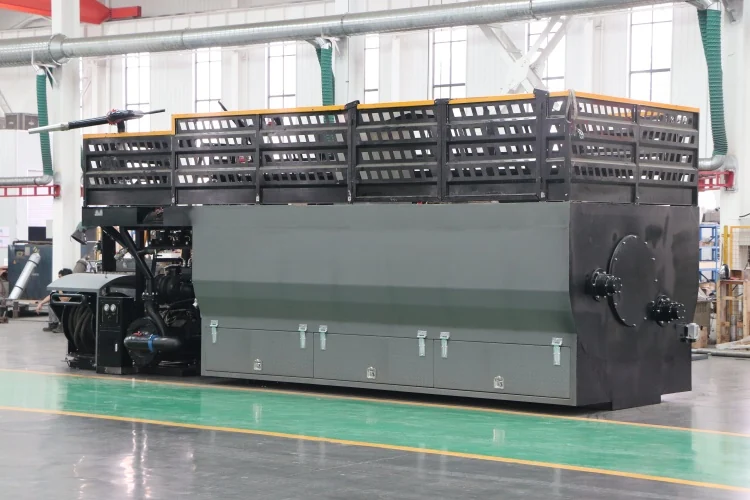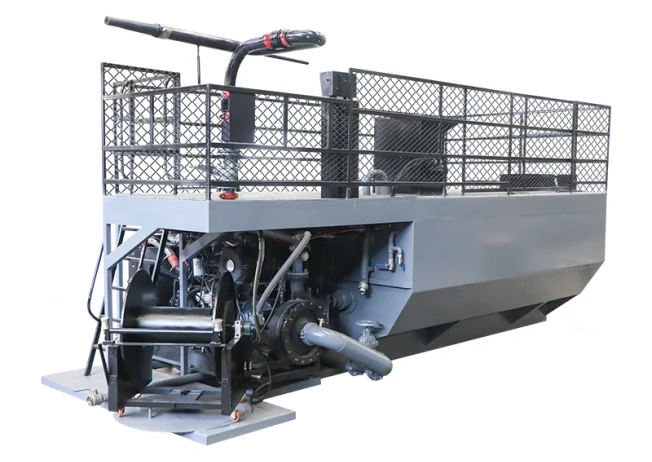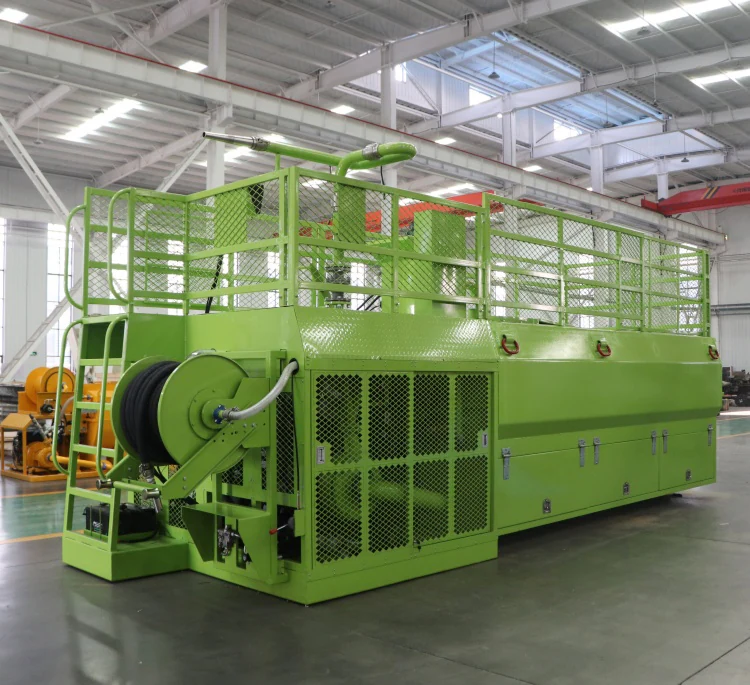
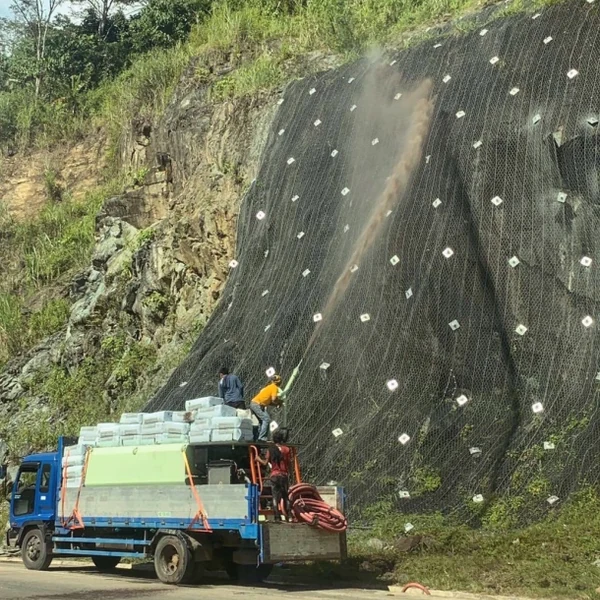
Choosing hydroseeding equipment for a mine rehabilitation project requires more than comparing tank sizes and advertised spray distances. The machine must handle your specified slurry, reach the treatment area and work within the site’s water, access and maintenance constraints.
Hydroseeding for mine rehabilitation works best when equipment selection follows the rehabilitation plan. Start with the required vegetation outcome and site conditions, then establish the material, pumping and production requirements.
This guide explains how to turn those inputs into a practical equipment specification, estimate achievable output and verify supplier proposals before committing to a machine.
What Hydroseeding Can—and Cannot—Do for Mine Rehabilitation
Hydroseeding applies seed in a water-based slurry through specialised mixing and spraying equipment. Depending on the project specification, the slurry may also contain fibre mulch, fertiliser, tackifier and approved soil amendments.
It can support vegetation establishment across disturbed ground, including prepared mine surfaces, quarry areas and embankments. Hydraulic application can also reach some areas where operating a conventional seeder directly on the ground would be difficult.
Hydroseeding and Hydromulching Serve Related Functions
Terminology varies between markets. Hydroseeding generally emphasises seed application, while hydromulching emphasises a hydraulically applied protective mulch layer. Some projects combine these functions in one application; others specify separate passes.
For procurement, define the actual materials and application sequence. A machine described as a hydroseeder is not automatically suitable for every hydraulic mulch or engineered growth medium.
Vegetation Establishment Is Part of a Larger Rehabilitation Process
NSW Resources describes mine rehabilitation in terms of making affected land or water safe, stable and sustainable. Applying seed is one activity within that broader objective.
Hydroseeding does not correct unstable landforms, uncontrolled concentrated runoff or unsuitable substrate chemistry. It also does not replace a project-specific response to contaminated materials or acid-generating mine waste.
Before specifying equipment, confirm which engineering, environmental and soil-management work must be completed first. A larger pump cannot compensate for an unprepared or unsuitable treatment surface.
Assess the Mine Site Before Specifying Equipment
A useful equipment enquiry begins with a site brief. This allows suppliers to evaluate the intended work instead of recommending a machine from total project area alone.
Map Treatment Areas, Slopes and Access Routes
Divide the project into treatment zones with similar conditions. Record:
Actual treatment surface area and how it was measured.
Slope length, inclination and elevation difference.
Safe vehicle positions and usable access routes.
Required hose routes and obstacles.
Areas needing different materials or application methods.
For sloping ground, clarify whether the stated area represents horizontal map area or the surface being treated. An area mismatch can distort both material quantities and production estimates.
Distinguish the machine’s operating position from the application area. A vehicle may reach a bench while the hose must travel around obstacles before reaching the slope.
Evaluate Soil and Growth-Medium Constraints
Mine rehabilitation site preparation should establish whether the proposed surface can support the intended vegetation.
Depending on the substrate and project risks, investigation may include soil texture, compaction, pH, salinity, nutrient availability and potentially harmful constituents. Waste rock, replaced topsoil and tailings should not be treated as interchangeable growing environments.
The rehabilitation team should determine whether the surface needs ripping, grading, drainage improvements, topsoil placement or another approved treatment.
These decisions affect equipment requirements. A seed slurry and a fibre-rich growth-medium application can impose different loading, agitation and pumping demands.
Confirm Water Availability and Work Windows
Document the water source, delivery route, filling arrangement and available storage. Confirm that the water is suitable for the seed, additives and equipment.
Also establish the application window using local climate, seed requirements and site conditions. A schedule suitable for a temperate site may be unsuitable for a tropical wet season or a cold-region project.
The practical question is whether the site can support repeated, consistent batches throughout the available working period.
Turn Site Conditions into Hydroseeder Specifications
A useful specification describes the work the equipment must perform and the evidence needed to demonstrate that performance.
Match Agitation to the Specified Slurry
Agitation must distribute the approved ingredients and maintain a sufficiently consistent mixture during discharge.
Compare systems against the intended materials, including fibre type, loading, seed characteristics and additives. Mechanical agitation is commonly considered for demanding fibrous mixtures, but the system label alone does not establish compatibility.
Ask the supplier to confirm the proposed loading and demonstrate the actual formulation or an agreed representative mixture.
A clean-water demonstration cannot establish fibre-slurry handling capability.
Verify Pump Performance for the Delivery Route
Pump pressure, flow, hose diameter, hose length, fittings, elevation and slurry characteristics all affect delivery.
Maximum pressure and maximum flow figures may describe different operating points. Neither figure, viewed alone, proves performance at the end of your proposed hose.
Likewise, an advertised horizontal spray distance does not establish uphill pumping capability.
Request performance evidence for the intended configuration. Where water-based pump curves are supplied, ask how the supplier will verify performance with the specified slurry.
Balance Tank Capacity, Payload and Access
Nominal tank volume is only one selection input. Ask for:
Usable working volume.
Permitted loading for the proposed materials.
Expected residual material after normal discharge.
Empty and operating weights.
Mounting and transport requirements.
Calculate operating mass from the machine, actual batch contents and accessories. Then check vehicle payload, axle loading and mounting arrangements.
A larger tank may reduce refill frequency, but it can also restrict access or require different transport equipment.
Connect Each Site Constraint to Evidence
| Site condition | Equipment requirement | Evidence to request |
|---|---|---|
| Fibre-rich slurry | Suitable loading, agitation and discharge capability | Recorded test using the agreed mixture |
| Long hose route with elevation gain | Adequate delivery under the specified configuration | Hose dimensions, elevation and measured test results |
| Restricted access | Suitable dimensions, operating mass and mounting arrangement | Dimensioned drawings and weight information |
| Remote water source | A workable filling and supply arrangement | Full-cycle production and water-delivery calculation |
| Limited maintenance support | Accessible service points and available wear parts | Parts list, maintenance instructions and service arrangements |
| Several treatment formulations | Reliable changeover and cleaning | Demonstrated cleaning and batch-change procedure |
Use this matrix to compare hydroseeding equipment for mine rehabilitation against a common brief. It makes missing evidence easier to identify before price becomes the deciding factor.
Match Seed, Mulch and Amendments to the Rehabilitation Plan
The equipment should deliver the approved treatment. Its limitations should be identified before materials are purchased or the work is scheduled.
Select Seed for the Intended Vegetation Outcome
Species selection depends on the rehabilitation objective, substrate, climate and local ecological requirements.
Where native vegetation is required, establish the permitted species and seed-source requirements. Clarify whether quoted seeding rates refer to bulk seed, viable seed or another specified basis.
Mixed seed sizes and treatments may affect handling. Confirm any restrictions on soaking, mixing duration and holding time with the seed specialist and relevant material instructions.
Select Mulch for the Exposure Conditions
Hydraulic mulch products differ in fibre composition, protective function and installation requirements. Ordinary fibre mulch, bonded fibre matrix and other engineered products should not be treated as interchangeable.
Selection should consider slope exposure, rainfall risk, soil conditions and the required protection period.
Concentrated flow may require additional measures designed by the project’s erosion-control or engineering team. Increasing mulch loading without reviewing the system is not a dependable remedy.
Verify the Complete Formulation
Confirm compatibility across the full mixture: seed, mulch, fertiliser, tackifier, amendments and water.
Check the mixing sequence, permitted loading and application instructions. If the machine cannot reliably handle the approved formulation, resolve that mismatch with the supplier and rehabilitation team before deployment.
Do not dilute or otherwise alter the treatment simply to make it easier to pump without approval.
Calculate Daily Output Around Water and Batch Cycles
Daily output depends on the complete working cycle, including filling, loading, mixing, spraying, relocation and required cleaning.
Some activities may overlap. A sound estimate measures elapsed cycle time rather than adding overlapping tasks twice.
Calculate Coverage from Material Quantity
For a treatment specified by dry mulch application rate:
Coverage per batch, ha = mulch loaded per batch, kg ÷ specified application rate, kg/ha
Consider an illustrative planning example:
| Input | Hypothetical value |
|---|---|
| Approved mulch quantity per batch | 200 kg |
| Specified mulch application rate | 2,000 kg/ha |
| Calculated coverage per batch | 0.10 ha |
| Elapsed complete batch cycle | 40 minutes |
| Scheduled operating time | 480 minutes |
The calculated coverage is:
200 ÷ 2,000 = 0.10 ha per batch
At 40 minutes per complete cycle, 480 minutes allows 12 batches:
12 × 0.10 = 1.2 ha per day
These figures illustrate the calculation only. They are not recommended application rates, equipment ratings or field-performance claims.
The proposed machine must still be approved for the batch loading and water quantity. Other ingredients must meet their own specified rates.
Test the Effect of Refill Delays
Suppose water delays increase elapsed cycle time from 40 to 60 minutes.
The same scheduled time now allows eight batches:
8 × 0.10 = 0.8 ha per day
Output falls by one-third, although the hydroseeder has not changed.
This is why water storage, filling arrangements or an additional supply vehicle may deserve evaluation before purchasing a larger tank.
Use Sustainable Output in the Purchase Decision
Replace assumptions with timed trial data wherever possible. Allow for inspections, breaks, cleaning, maintenance and interruptions that are not already included in the measured cycle.
Keep initial application cost separate from rework and establishment costs. A low cost per sprayed hectare can be misleading if inconsistent application creates additional work.
For mine revegetation equipment, the useful comparison is the cost of delivering the specified treatment under realistic site conditions.
Run a Site Trial Before Full Deployment
A trial should answer two separate questions:
Can the equipment consistently deliver the specified treatment?
Does the treatment perform appropriately on the prepared site?
These questions require different records and observation periods.
Test the Intended Configuration
Agree on the trial formulation, batch loading, water source, hose dimensions, delivery route, elevation and nozzle configuration.
Record mixing time, discharge behaviour, interruptions, residual material and cleaning time. If practical, use repeated batches to check consistency rather than relying on one successful demonstration.
Define acceptance criteria before the test. Criteria should come from the project requirement, material instructions and agreed equipment specification.
Use Clear Acceptance and Escalation Decisions
| Trial item | Accept when | Correct or escalate when |
|---|---|---|
| Mixing | Agreed ingredients can be loaded and distributed as required | Persistent dry pockets, separation or repeated manual intervention occurs |
| Delivery | The mixture reaches the application area at the agreed working rate | Delivery cannot be sustained under the specified route and elevation |
| Application | Material use and measured area support the specified rate | Coverage relies only on visual colour or batch records do not reconcile |
| Batch completion | Residual material and cleaning meet agreed requirements | Retained material makes output inconsistent or cleaning impractical |
| Site response | Monitoring meets project-specific assessment criteria | Washout, poor establishment or substrate issues require specialist review |
A failed item does not automatically mean the entire system is unsuitable. It identifies a problem that must be resolved and, where necessary, retested.
Separate Machine Acceptance from Rehabilitation Success
Machine acceptance can establish that the equipment mixes and delivers the agreed slurry under defined conditions.
Vegetation establishment also depends on substrate, seed quality, timing, rainfall and aftercare. Longer-term rehabilitation assessment may include species composition, erosion performance and other site-specific objectives.
A short equipment demonstration cannot prove long-term ecological performance. Keep those responsibilities and assessment periods distinct in the contract.
Compare Supplier Proposals Using the Same Project Brief
Send shortlisted suppliers the same treatment requirements and site information. Ask them to identify assumptions, exclusions and any condition requiring further testing.
Request Comparable Technical Offers
Each proposal should identify the offered configuration, usable capacity, material-loading limits, agitation system, pump, hoses, nozzles, operating weights and required support equipment.
Require written confirmation of the trial conditions. A general statement that a machine is “suitable for mining” provides little basis for acceptance.
Include Training, Parts and Field Support
For remote sites, evaluate how routine service and unexpected repairs will be handled.
Confirm:
Operator and maintenance training.
Parts identification and recommended initial spares.
Availability of seals, valves, hoses and other relevant wear components.
Warranty coverage and exclusions.
Remote diagnostic support and field-service arrangements.
Assess the proposed support model against the site’s own maintenance capability and supply lead times.
Define Application and Aftercare Responsibilities
Clarify who supplies the materials, prepares the surface, approves the formulation and provides water.
Also define responsibility for application records, weather-related stoppages, monitoring, aftercare and corrective work.
This helps prevent a machine-performance issue from being confused with a material, site-preparation or establishment issue.
Frequently Asked Questions
Can one hydroseeder serve different rehabilitation zones at the same mine?
Yes, provided each formulation and delivery configuration falls within its verified capabilities. Check loading limits, changeover requirements, cleaning and the production implications of serving several zones.
Can a hydroseeder use non-potable site water?
Potentially, but suitability must be assessed. Water chemistry and suspended material can affect seeds, additives, equipment and environmental acceptability. Obtain project-specific approval rather than assuming that any available mine water is suitable.
What if the final slurry specification is not available?
Request a preliminary equipment assessment based on clearly stated assumptions. Keep final selection and acceptance conditional on the approved formulation and delivery requirements. Avoid treating an assumed mixture as a confirmed operating specification.
Is a larger hydroseeder always better for mine rehabilitation?
No. Larger capacity may reduce refill frequency, but access, operating weight, water supply and material handling can limit its value. Compare complete-cycle output and total deployment requirements.
Successful hydroseeding for mine rehabilitation starts with a defined site and treatment plan. Use that plan to establish equipment requirements, test realistic production assumptions and agree on measurable acceptance conditions.
Before requesting a final quotation, prepare a project brief covering treatment area, substrate, formulation, water supply, hose route, elevation and required output. Ask suppliers to return a proposed configuration and a test plan that addresses those conditions.